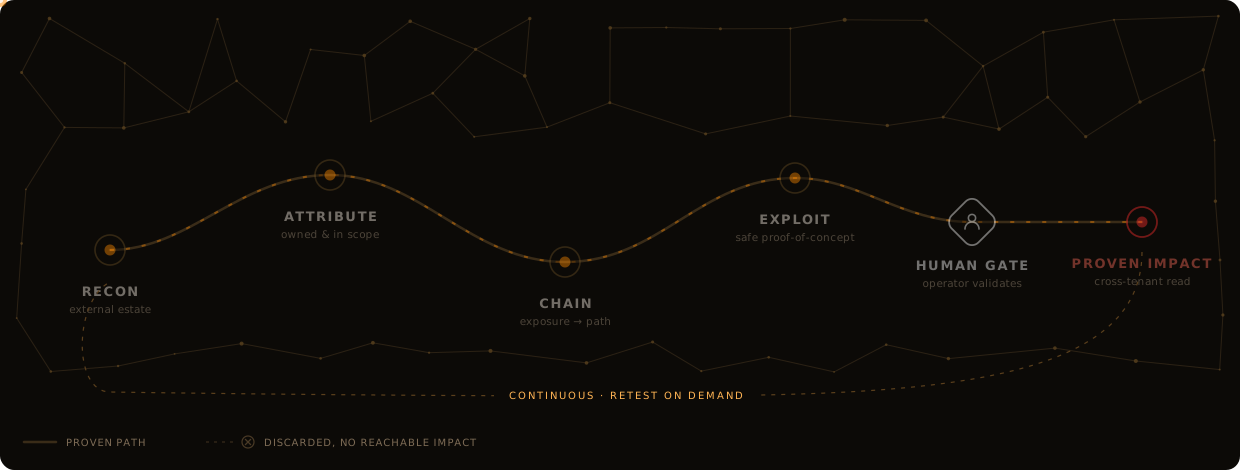
Reconnaissance & discovery
Passive and active discovery across DNS, certificate transparency, cloud ranges, OSINT corpora and breach data builds the real external estate, including the subsidiaries and shadow IT your inventory never captured.
Exceed runs an agentic penetration test across your enterprise attack surface: mapping the estate, chaining exposures into real attack paths and building a working proof-of-concept. Then elite offensive operators validate every finding by hand. Nothing reaches your report that we could not exploit.
Your SOC 2, ISO 27001, PCI DSS or DORA penetration test evidence, delivered in hours of testing instead of a six-week consultancy bench, at a fraction of day-rate pricing.
Authorised testing only · Scope & asset ownership confirmed before testing · NDA on request
Every enterprise already owns tooling that produces findings. Almost none can answer the only question that matters to a board: can someone actually get in, and how far do they get?
Acquisitions, regional subsidiaries, forgotten staging, expired-but-live DNS and shadow SaaS expand the perimeter faster than asset inventory can record it. You cannot defend an asset nobody wrote down.
Severity without reachability produces a queue nobody drains. A 9.8 behind mutual TLS matters less than a 6.5 on the path to your customer database.
Engineering closes tickets that carry a reproducible proof-of-concept. They deprioritise tickets that carry a scanner plugin ID and a maybe. Evidence is what converts a finding into a fix.
You ship weekly and your perimeter changes nightly, but assurance arrives annually, usually six weeks after the scope was frozen. The report describes a company that no longer exists.
Agents do the work that scales: enumeration, attribution, chaining, exploitation attempts at a volume no consultancy can bill for. Operators do the work that does not: judgement, business context and the decision about what is genuinely exploitable.
Passive and active discovery across DNS, certificate transparency, cloud ranges, OSINT corpora and breach data builds the real external estate, including the subsidiaries and shadow IT your inventory never captured.
Every discovered asset is attributed to the right legal entity and checked against the authorised scope. Nothing outside your written rules of engagement is touched, and misattributed assets never enter the test.
The engine reasons over the estate the way an operator would: enumerate, pivot, chain. It tests authentication, object-level authorisation, injection, business logic and misconfiguration, then attempts to connect them into a path that reaches something that matters.
An offensive-security operator reproduces every candidate finding by hand, re-rates it against your business context, discards anything without reachable impact and extends the path where the engine stopped short. This gate is why your report has no false positives in it.
You receive an executive summary your board can read, per-finding CVSS 3.1 vectors, CWE mappings, reproduction steps, proof-of-concept evidence and remediation guidance your engineers can act on without a follow-up call.
We stay on the fix. When your team ships the remediation we retest the affected paths and issue a signed retest attestation, the artefact your assessor actually asks for at audit time.

An AI-only product will hand you volume and leave the triage bill with your team. A traditional consultancy will hand you judgement, eight weeks later, for a six-figure invoice. We refused to pick.
This is the step AI-only platforms skip, and the reason their output lands on your team as a triage backlog instead of a decision.
Not a wall of plugin output. We test for the classes of weakness that connect an outsider to your data, your money or your production control plane.
Shadow IT, forgotten staging, expired DNS takeover and exposed management interfaces.
BOLA/IDOR, broken function-level authorisation, injection, SSRF and unsafe file handling.
Active Directory and Entra ID attack paths, session flaws, SSO and federation abuse.
AWS, Azure and GCP privilege escalation, IAM trust-policy abuse and exposed storage.
Multi-tenant isolation, workflow abuse and the paths scanners have no model for.
Segmentation testing: what the first foothold actually reaches inside the boundary.
Leaked credentials, keys in public repositories and tokens recoverable from client code.
Supplier and subsidiary exposure that reaches your estate through a trusted integration.
One document serves three audiences: an executive summary and risk posture for the board, a per-finding technical section with CVSS 3.1 vectors, CWE mappings and reproduction steps for engineering, and a methodology and scope appendix for your auditor.
Fully anonymised. No client-identifying information is included.
Most enterprises buy a penetration test because an auditor, a regulator or an enterprise customer's security questionnaire demands one. Exceed produces that evidence on your timeline, and the testing underneath it is real enough that you would want it anyway.
Independent evaluation of controls and vulnerability detection, with the evidence package your service auditor expects to see in the control narrative.
Technical vulnerability management and security testing in development and acceptance, documented to survive a Stage 2 audit and surveillance visits.
Internal and external penetration testing plus segmentation validation, including the retest evidence required after remediation of exploitable findings.
Digital operational resilience testing for financial entities, up to and including threat-led penetration testing for in-scope institutions.
Security testing and effectiveness assessment of risk-management measures for essential and important entities operating in the EU.
Intelligence-led adversary simulation run to the TIBER framework by a team with prior TIBER-EU engagement experience.
Exceed delivers the technical testing and evidence that support these requirements. We are not your auditor, assessor or QSA, and no engagement constitutes a certification.
| Traditional consultancy | AI-only pentest tool | Exceed CyberSecurity | |
|---|---|---|---|
| Time to report | 6 to 8 weeks, bench permitting | Hours | Hours of testing, report in days |
| Cost structure | Senior day rates × team × duration | Subscription or usage-based | A fraction of day-rate pricing |
| Coverage | What fits the booked days | Broad, shallow, automated | Agentic breadth, operator depth |
| False positives | Low, humans triage | Pushed to your team as backlog | None, every finding reproduced |
| Attack-path chaining | Yes, within the booked window | Limited, product-dependent | Yes, chained then operator-extended |
| Retest | Change order, re-booked | Re-run the scan yourself | Included, with signed attestation |
| Between engagements | Nothing until next year | Continuous, unvalidated | Continuous, validated on change |
| Who stands behind it | The named consultant | A model and a support queue | A named offensive operator |
Fixed-fee, no day-rate meter running. You know the price and the delivery date before testing starts.
For the audit, the regulator or the enterprise customer blocking your deal.
For estates that change weekly and assurance that cannot wait for next year.
For regulated institutions and mature programmes testing detection, not just exposure.
Exceed is not a scanner with a marketing page. The engine encodes the methodology of an offensive security practice that has spent fifteen years inside enterprise networks. Legally, under contract, and usually before anyone else got there.
Enterprise red teaming, adversary simulation, exploit development, TIBER-style engagements, Active Directory and Entra ID attack paths, cloud privilege escalation, and IoT and embedded security research.
The team behind Exceed has delivered offensive security work for organisations including the following, alongside TIBER-EU engagements and published security research.
Every validation gate is staffed by a certified offensive-security practitioner with exploit development and red team experience behind the certification.
Engagements are covered by NDA. Client identities, targets, findings and reports stay private unless you give explicit written permission to disclose them. The sample report on this site is fully synthetic.
Request our NDA and scoping packExceed is backed through QSTP, an innovation ecosystem supporting deep-technology companies from prototype to global deployment.
More about the team at Hacktivity.euIt is a penetration test. The agentic engine performs reconnaissance, attribution, exploitation and attack-path chaining, and an offensive-security operator validates every finding by hand before it reaches your report.
Automation changes how fast and how broadly the work gets done. It does not change the fact that a qualified human stands behind every claim in the deliverable.
The report is written to the structure assessors expect: scope and rules of engagement, methodology mapped to OWASP WSTG, the OWASP API Security Top 10 and PTES, per-finding CVSS 3.1 vectors and CWE references, reproducible evidence, remediation guidance, and a retest attestation once fixes land.
It supports SOC 2 CC4.1 and CC7.1, ISO 27001:2022 A.8.8 and A.8.29, PCI DSS 4.0 requirement 11.4, and DORA threat-led testing evidence. If your assessor has a specific evidence format, tell us on the scoping call and we will produce it.
Agentic testing completes in hours. Operator validation, severity re-rating and report writing follow, so a scoped engagement typically produces a draft report within days, against the six to eight weeks a consultancy needs before its bench frees up.
If you are against an audit deadline, say so on the scoping call. We schedule around deadlines, not around our calendar.
A finding ships only if two conditions hold: the engine built a working proof-of-concept, and an operator independently reproduced it. Candidates that fail either test are discarded rather than downgraded into your backlog.
That is why our reports are short. A ten-page report of proven issues is worth more to your engineers than a 300-page export nobody reads.
Production testing happens only with explicit written authorisation, a confirmed scope and an agreed testing boundary. We verify asset ownership before a single packet is sent.
Testing is non-destructive by default. State-changing actions are demonstrated only to the point of proving the weakness, denial-of-service is out of scope unless separately contracted, and you get a named operator contact reachable throughout the testing window.
Attack surface management tells you an asset exists. A vulnerability scanner tells you a version string looks vulnerable. Neither tells you whether an attacker can reach anything that matters through it.
Exceed demonstrates the path end to end and hands your team the proof-of-concept that turns a deprioritised ticket into a shipped fix. Many clients run us alongside their existing ASM rather than instead of it.
Engagement data is handled under NDA, stored encrypted, segregated per client and retained only for the contractually agreed period before secure destruction. Findings are never used as marketing material, and client identities are never disclosed without written permission.
Our standard NDA and data-handling appendix are available before scoping. Ask for them on the call.
Scoping takes one 30-minute call. Once scope and authorisation are signed, testing starts immediately. There is no bench to wait for, because the breadth of the work is done by the engine rather than by booking consultant days.
Thirty minutes. You leave the call knowing exactly what we would test, what it costs, and the date the report lands. No procurement theatre, no discovery-call funnel.
Fixed fee · Scoped in 24 hours · Retest included · NDA on request